


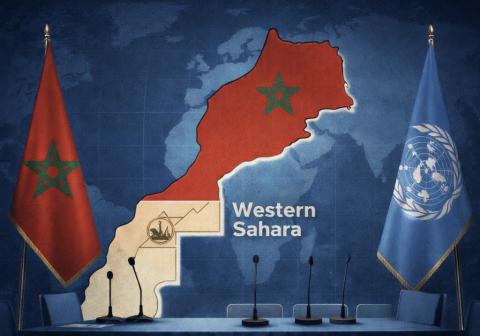
At the moment when the Western Sahara negotiations returned to the forefront of U.S. attention through the recent Madrid meeting and its preceding preparations, it became clear that the event, in essence, had gone beyond being merely another stop in a familiar UN process. Rather, it signaled that the file is gradually shifting from a state of a “deferred conflict” to that of a “possible settlement,” one driven by a distinctly geopolitical logic that prioritizes feasibility over the completeness of a legal formula. The latest UN decision—whatever its formal language—does not appear as a final ruling so much as a framework that prepares the ground for certain options while sidelining others. It grants some proposals greater momentum by virtue of power balances and partner interests, foremost among them the autonomy approach, which is now presented as the solution closest to political realism.
In this sense, Mauritania’s question within this process becomes a question of positioning before it is a question of stance. Mauritania has not historically been absent from this file, but it is now facing a different moment in which the very function of participation is changing. A shift toward a logic of “implementation” means that each party will be assessed based on its capacity to manage sensitive nodes and guarantee stability on the ground, not on rhetorical eloquence or the strength of its attachment to slogans. Hence, Mauritanian neutrality ceases to be merely a refusal to take sides and becomes a negotiable asset that can be converted into gains if properly deployed within a defined package of interests related to border and coastal security, the economy of the Nouadhibou region, the openness and regulation of trade corridors, and the prevention of the southwestern strip becoming a permanent vulnerability that raises Mauritania’s cost of stability without compensation.
If the United States is indeed pushing autonomy as a geopolitical exit from a chronic deadlock in Northwest Africa, then the same geopolitical logic opens a different window of demands for Mauritania—distinct from direct territorial claims. This would rest on the idea of a “special transitional arrangement” in the La Güera–Ras Nouadhibou area, incorporated into monitoring and guarantee mechanisms so that it becomes part of the settlement’s overall cost. The intent here is not to revive the maps of 1975 nor to enter into a sovereignty competition that could disrupt the process, but to establish a simple truth in the language of interests: when a settlement advances on the basis of feasibility, a state bearing the burden of borders has the right to request clear, written, and measurable functional compensation ensuring that “realism” does not come at its expense.
The Geopolitical Shift in the Settlement Path and the Meaning of Autonomy as a Power Option
The Western Sahara process is no longer moving under the same logic that governed it for decades, when the United Nations essentially managed time and kept the door open to contradictory formulas without imposing the real cost of decision on the parties. What emerges after the latest UN decision and the U.S.-sponsored Madrid meeting is a gradual transition from “conflict management” to “settlement management”—from an economy of freezing the situation to an economy of implementation. This transition is shaped less by law itself than by power balances, regional calculations, and the interests of international partners who increasingly see the file as a knot obstructing the architecture of stability in Northwest Africa and complicating broader priorities such as Sahel security, migration control, the safeguarding of trade routes, and the reconfiguration of energy and maritime partnerships along the Atlantic coast.
Within this shift, autonomy should be viewed as a tool to reduce “sovereignty ambiguity” rather than to resolve it theoretically. It is an attempt to close the space of uncertainty that allows crises to recur whenever the regional or international context changes. It is promoted as the least costly solution for the international system because it offers a stability formula that is marketable within Western decision-making institutions, compatible with the on-the-ground realities accumulated by Morocco over time, and simultaneously presentable as a political concession ensuring local representation for Sahrawis and mitigating the objections of their supporters—even if deeper legal questions remain unresolved. Thus, “realism” becomes the practical criterion of decision-making, where what preserves stability and reduces the reproduction of tension takes precedence over what merely aligns with abstract legal texts in a region burdened by intertwined crises that do not allow indefinite postponement.
This logic gains traction because its backers do not view the file in isolation but as part of a broader redesign of Northwest Africa as a contact belt between the Mediterranean, the African hinterland, and the Atlantic. In this configuration, Algeria and Morocco appear as competing poles shaping the space, Mauritania emerges as a rising pivot as the Sahel’s gateway to the Atlantic, and Western Sahara becomes more a zone of passage and positional consolidation than a classic border dispute. Relaunching consultations under U.S. sponsorship—even if wrapped in traditional UN language—reflects a desire to narrow the maneuvering space that perpetuates the conflict and to produce interim, implementable outcomes that reduce friction and recalibrate sensitive corridors. The cost of leaving the file suspended is now spilling over into more urgent Western priorities.
Accordingly, autonomy as a geopolitical orientation implies two interconnected realities for Mauritania. First, the process no longer asks neighboring states about their “moral position” on the conflict but about their “functional role” in ensuring post-settlement stability, opening a new negotiating window for states that hold practical keys to implementation. Second, the move toward implementation will inevitably create winners and losers—not only through declared maps but through the security, economic, and transit arrangements drafted in annexes and margins. This is precisely the space where Mauritania can maneuver intelligently, provided it recognizes that geopolitics rewards those who demonstrate their ability to manage sensitive nodes and share the cost of stability in ways that make others dependent on their role.
The Possible Mauritanian Package: From Neutrality to a “Special Status” for La Güera as a Transitional Arrangement
If the geopolitical shift favors implementable solutions over definitive legal closure, Mauritania is not required to choose between a silent neutrality that forfeits gains and a sovereignty-driven push that disturbs balances. The smarter space lies in between, where neutrality becomes a productive negotiating tool. Historically, Mauritanian neutrality was not simply ethical distancing but a cost-reduction strategy after the war experience, a way to protect domestic stability and avoid becoming a rear base for a draining conflict. Yet when the file moves into an implementation phase, neutrality alone is insufficient, as it risks seeing post-settlement arrangements shaped without Mauritania, only for it to be asked later to provide humanitarian, security, and logistical functions as a fait accompli.
Mauritanian diplomacy should therefore redefine its participation as maximizing “functional gains” rather than sovereignty gains. Mauritania does not need to reopen the maps of 1975 nor revive partition narratives that politically ended in 1979. However, it possesses sufficient historical and geographic grounds to seek clear functional compensation translating the burden of borders into guarantees and benefits. This is rooted not only in the past but in present realities: Nouadhibou as the maritime heart of the Mauritanian economy, Ras Nouadhibou and La Güera as contact nodes between Mauritania’s coast and a contested space, and the fact that any disturbance there affects not just sovereignty lines but the state’s economic breathing space, maritime and land corridor protection, and the prevention of smuggling, irregular migration, and crime exploiting gray zones.
On this basis, Mauritania could propose a “special transitional status” for La Güera pending a final settlement—not as a sovereignty claim or annexation demand, but as functional engineering that removes the area from ambiguity. This should be structured as a three-part package: a security component with clear coastal and border monitoring, information sharing, and movement rules; an economic-logistical component linking the area to Nouadhibou’s service and corridor matrix; and a governance component embedding these arrangements within monitored mechanisms tied to the UN track and U.S. sponsorship, ensuring they are written, measurable, and enforceable.
Such an approach grants Mauritania gains without exiting neutrality. It frames the country not as a map-changing actor but as a contact state seeking transitional management to avoid new fragilities on its borders. It is also marketable as a stability instrument rather than an alignment tool. In a context where autonomy is driven by international balances, Mauritania’s realistic ceiling lies not in sovereign titles but in a special status ensuring that the geopolitics advancing the settlement does not turn against it, and that its maritime and border security and the Nouadhibou economy are integrated into the success conditions of any durable settlement.
Odghust Center for Regional Studies
.jpeg)













.jpeg)